
Saints and roadkill
Why I keep digging shallow graves in my garden.

Hello again.
Or hello for the first time if you have recently joined. It is a bright morning here at the end of March. Steam from my boiler drifts across the view of the playhouse at the end of my little garden and across the square of the upper window, almost entirely blue. I have not been outside yet. Maybe one square of blue is all I can cope with. I must go down to the end of that little garden and dig a little grave. It is Saturday and there is one week more of Lent.
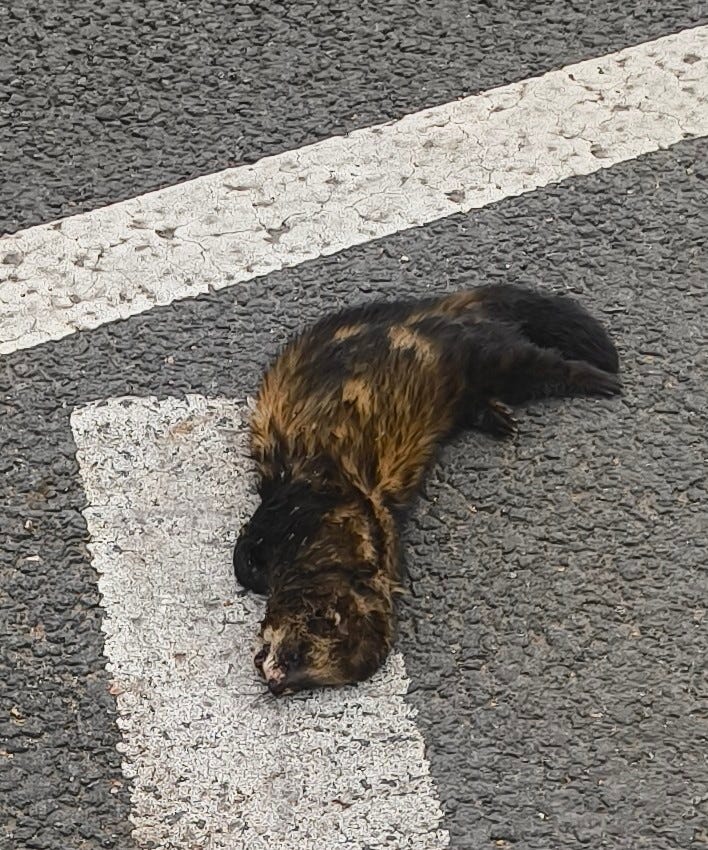
The day before yesterday, after returning from work at the forest school and knocking back a quick cup of tea, I drove into Cambridge for an event at my son’s school about university applications. On the way there I saw something on a rural traffic island which I wanted so, on the way back, I took a side road and parked the car and ran back to the main road with a bin bag to pick it up. Last time I did this, I had found only a curl of stripped tire I had convinced myself was a young otter. This time I was sure, though. It was a polecat dead on the road.
Polecats are the wild cousins of the ferret and like many of the birds and beasts once exterminated by gamekeepers, they have spread spectacularly across England in my lifetime. They are still quite rare and elusive, though and I have never seen a live one but have found them a few times on the road. Being smallish animals, they are not usually flung aside like badgers or muntjac, but are run straight over and crushed and therefore no use to me. This one was curled soft as someone’s sweet pet that had died in its straw. Her long coat wisped about her body like the soft awns of barley, seeming too long and luxy for a working wild thing. That is how they are, though, at least when when they are not flattened to teeth and shoe-leather like the last two I found, or in bits like the young rabbit beside her. She was beautiful, a deep chocolate or mahogany brown with minty-bright white markings on her the short fur of her face. That is what I remember anyway. You can see in the picture it isn’t quite right. It is a combination of colours that I am prone to seeing, that still sends up the hairs on my own neck.
That is only in retrospect though. I didn’t make the connection with the saola at the time. I didn’t say ‘she’ then either; she was an ‘it’. I grabbed its thick tail through the bin bag, as I had bagged up dog turds all last week and I pulled the bag up round it. I tied a knot and ran back to dump it in the boot of my car, apologize to my son and head home.
The bag is now in the garden in a grave which is too large because it was dug for a fox which turned out to have had its head smashed in. There is a badger, though, neatly buried beside it under a stone. The idea is to dig them up after a year when they’re bones and show the bones to children at the forest school or something. I don’t have to say where I got the bones and a lot of kids are interested. It was an idea I had for a while but didn’t do it. In the end I had to do it because I had to deal with that corner of the garden and tend the vine there. When it was a question: “shall I dig the graves or not?” I said yes, because I never decide not to do something, only fail to complete.
This March I had decided to prepare some stories for a camp that we are helping run in some nearby woods in the summer. There are workshops and campfires and children running wild through the fields and I tell stories in the evening. Last year I told a big story to the adults too and this year people said they wanted something more local. So we have settled on stories for our river, the Granta or whatever you call it, the river which rises at Ashwell and meets the sea by King’s Lynn.
Also this March I had decided to hold off from a few things for Lent: things like snacks and television. I also went to prayer sessions at the church because I don’t know how to pray. These last two weeks, the corners have been knocked off my resolve rather. I don’t, it seems, have the faith for it. That is a whole story which somehow or another, I will probably have to tell. I will wonder, the whole time I am telling it, whether it is lies and excuses. That is going to make it difficult to tell, but I am at least used to that kind of thing.
Anyway, yesterday I had to take the car in to be serviced. I had forgotten all about that on Thursday when I scooped up the polecat and was congratulating myself on having done that when I had the chance. I would not have been able to go back the next day and get it because I would be all day in the cafe near the garage. In the car, because it is Lent, I listened to a recording of G.K. Chesterton’s book about Saint Francis of Assisi. The narrator pronounced it ‘Asissy’ and I could not help but shout out to correct him every time. I got a bit annoyed with Chesterton too because the paradoxical aphorisms come a bit too thick but sometimes he pours a whole paragraph of pure beauty out.
Chesterton addresses “the ordinary modern man, sympathetic but sceptical” and says he will start with the aspects of the saint that such a man will find appealing. If he can show the saint’s praise for the sun, the gentleness with the wolf, the fire of love in his heart then maybe, he ‘hazily hopes’ he can give this modern man an inkling also of why Francis should hide in a cave and be so harsh to his own ‘ass’ that he forced it to roll it in the snow. The dark ages, Chesterton says, were a long expiation for a sin of the ancients who reached, perhaps, the highest level of civilization and so reached the heights where they could see their own mistake. The mistake, he says, was nature worship and the paradox was that “the wisest men in the world set out to be natural; and the most unnatural thing in the world was the very first thing they did.”
I do fear, and this time in greater alignment with my friends, what the expiation for our current civilization will look like. I fear that a lot. But this kind of statement is why I find it hard to have much faith in Christianity, this kind of thing. Although I can hear the counter-claim that it must be, in fact, my great excuse. I am amazed by the ease, though, with which Chesterton can glibly state sixty-four years after Darwin, that homosexuality is ‘unnatural’ as if that meant anything at all. Many people, perhaps most people I know, have sufficient faith in their political opinions to cast an idea like this out with a vicious and civilized scoff. I can’t do that, just because I can’t access sufficient faith in that area either. I don’t know how to know, really, what is right and wrong.
I have great faith, though, that homosexuality is not unnatural because it is everywhere in the natural world and, just in case anyone had forgotten, understanding that natural world requires no assumption of a plan or a design. People are always trying to claw their way back to Platonism that way, invoking teleology as if it were some kind of heresy that science is scared of, rather than an old idea we simply don’t need. They think they are exposing small-mindedness, opening to ancient wisdom, trashing machine-age paradigms. I think they should take the hit.
But that, once again, in another story. Last night I was thinking of a much less famous saint: Saint Withburga. She was a saint at Dereham whose work survived a famine because a wild doe gave her milk. The story goes that the Abbey of Ely already had the bones or bodies of Etheldreda, Ethelburga and a third saintly sister with a rather unfortunate name. They wanted Withburga too and claimed, perhaps because they wanted her, that she was also a daugher of Onna of the East Angles. I am thinking of this story because it involves the river. After the monks got the men of Dereham drunk and stole Withburga’s body, a spring burst forth from her ruptured tomb. Also it is supposedly said that a barge rowed by phantom body-snatching monks can be seen sometimes in the mists of the Little Ouse.
Well I was thinking over this story, among others, and I was struck with a problem of characterization. I won’t portray Brithnoth, the abbot of Ely as a cartoon villain; even though there was a fenland tradition of showing the monks in this light. Instead I was wondering what would get such a man to such a ludicrous pass and I remembered how I felt about the polecat’s body, still in the garden and still in its bag.
I would like to keep the body entire with that soft coat on it but there is no room in my freezer and I don’t know any taxidermists. The bones will have to do. The abbey at Ely were luckier. Supposedly, when they opened the tomb at Ely, Withburga’s body was still flexible, rosy and firm-breasted two and a half centuries after her death. I had better check that reference because I would like to imagine what it is like to be a monk breaking into the tomb of a saint and deciding it’s a good idea to poke her breasts to see if they are still firm, but I just can’t. I mean seriously? Now I am feeling a bit of that vicious, civilized scoff. And yet I want to go out there right now as I’m writing and open the bag and look at my treasure, even though I fear there might be maggots.
But, as I was lying there I remembered also, that snaggle of young rabbit bits on the road beside her and wondered, then, if it hadn’t been another roadkill, but her prey. Polecats mostly kill rabbits in England. I pictured her trotting across the road with her head held high feeling, so pleased with herself to have got this prize, just as I had on finding her.
And I thought “why was she carrying the rabbit somewhere else?” That is when I started thinking of her as ‘her’. She could have been taking it somewhere quiet to eat in private, of course, but it is possible also, as its springtime, that it wasn’t for herself.
I haven’t checked. As I said, the fur is very long and thick. Maybe when I open the bag it will turn out that it is a male. I hope so. It was always a worry of mine that we would catch a saola and find she was lactating. What then? The one captive saola that Bill Robichaud spent time with, and called ‘her’ also - named even - turned out to be pregnant and I have seen her foetus in a jar.
I have been thinking about the saola less of late and suddenly, in March, I find that I am working on three separate articles about it. It just happened and it is one of the reasons that I am late getting the stories together.
It wouldn’t be hard to give a modern explanation of why Francis rolled his body in the snow. You just say he was a kind of spiritual athlete and that was part of his training. Chesterton doesn’t say that, he says he did it because he was in love.
And there is a dead buck muntjac on a farm on the Fulbourn road and I want that too. I still want him. Want.
Hello: good to see you are still writing. I miss reading your stuff. And now you are in my territory with roadkill. Last time I was in Cambridgeshire we went to a prehistoric farm site in the fens and found a road kill water deer. The fen roads are narrow and too busy for stopping, but my brother was undaunted and pulled over. We caused a traffic jam. Sadly the head had been crushed and one long shard of canine lay on the road. I took a photograph instead. Amazingly, i sold this image after being contacted by a writer who needed a shot of a roadkill water deer. I found a polecat in Hertfordshire too, many years and stopped to photograph it. I was unsure then if it was a wild or feral animal. I go to Australia in a few days. The road kill there is copious and our road trips punctuated by frequent stops. I have been meaning to contact you about that Katu village we stayed in - I can never recall the name. There was an old woman, round and red as an apple, who claimed to have shot down an American plane when she was a girl. Were you there that time? Do you remember it? Or did you hear the story some other time? Was it true? I told it recently and everyone accused me of making it up.
This was so good Nicholas. Also, happy to explain / show you how to case skin mustelids anytime so you can save / dry / tan / ask me to tan their skins.